
Loyalty points
Module Description

Module manual
Index
- Description
- Install
- Category Settings
- Assign categories to clients when creating or editing
- Assign points program from list
- Add or remove points manually
- Earn points from standard Dolibarr invoices
- Earn points from TakePOS invoices
- Use bonus points on standard Dolibarr invoices
- Use bonus points on TakePOS invoices
- Printed receipts and invoice
- Permissions
- Product and category filters
- Calculation base
- Category hierarchy
- Include/exclude priority
- Histories (audit log)
- Changelog
1. Description: The Loyalty Points plugin consists of a functionality that allows you to give points as a bonus to customers for their purchases in our business, it allows you as an owner to create categories for your customers, rewarding those who are most loyal with a greater bonus and thus being able to maintain a closer relationship with them, the functionality allows you to apply or earn points from both financial or standard Dolibarr invoices and those generated from Dolibarr's favorite point of sale "TakePOS"; give your customers an incentive to return to your business.
2. Install: To install the module, proceed with the normal process for any external module, from the configuration section for installing external Dolibarr modules, or if you have greater technical knowledge you can install it in the "custom" directory of your Dolibarr, below We present how to install it from the functionality of external modules:
3. Category Settings: Once the module is installed, you can proceed to its configuration, the functionality allows us to have one or more categories of points for our clients, we can decide if we manage only one for everyone in general or if we manage several for different clients and thus reward with more or fewer points depending on a given classification. Below we can see how categories are configured for the loyalty points program:
4. Assign categories to clients when creating or editing: When we create a new client in the system we can configure that a certain category of the points program is assigned by default, this allows us to equitably grant clients the benefit, first we must mark a default category in the category configuration shown in point 3 "Category Settings", and then when creating the client this category will be loaded by default to the new client, the following video shows the process:
5. Assign points program from list: The loyalty program has a list that shows customers affiliated with the program, it has filters to show non-affiliates or those affiliated with a specific category, in the same way you can assign a category massively to customers or massively disconnect customers from the program. program, below is the process:
6. Add or remove points manually: Loyalty Points allows you to manually assign points to your customers, simply adding or subtracting the points on the customer's file in your Loyalty Points section, below we show you how to do it:
7. Earn points from standard Dolibarr invoices: One of the ways to provide the benefit of points to our clients is through the creation of Dolibarr financial invoices, once the invoice is validated and paid it will add points to the client according to the parameters established in the category to which it belongs, let's see this next:
8. Earn points from TakePOS invoices: As a main advantage, Loyalty Points offers the possibility of granting points to customers through the favorite Point of Sale of Dolibarr TakePOS, once the invoice is paid the customer will obtain points, in the following video we can see the process:
9. Use bonus points on standard Dolibarr invoices: To redeem the points obtained by clients, the necessary amount can be used to pay the invoice balance from the Dolibarr financial module. The amount necessary to pay the invoice will be automatically charged for greater ease. Below we can see it. :
10. Use bonus points on TakePOS invoices: From the point of sale you can also redeem the points, the amount necessary to pay the invoice will be automatically charged for greater ease, you can also use change the amount to use a partial amount of points and pay the rest with another form of payment. payment, below is the process:
11. Printed receipts and invoice: For both standard and TakePOS invoices, a display is provided for the points obtained, used and everything related to them. For standard invoices, the "loyaltypoints" printing format must be activated, which will be found in the configuration of the module. invoices, below are screenshots with the invoice data and purchase receipt:
 Factura estándar de Dolibarr
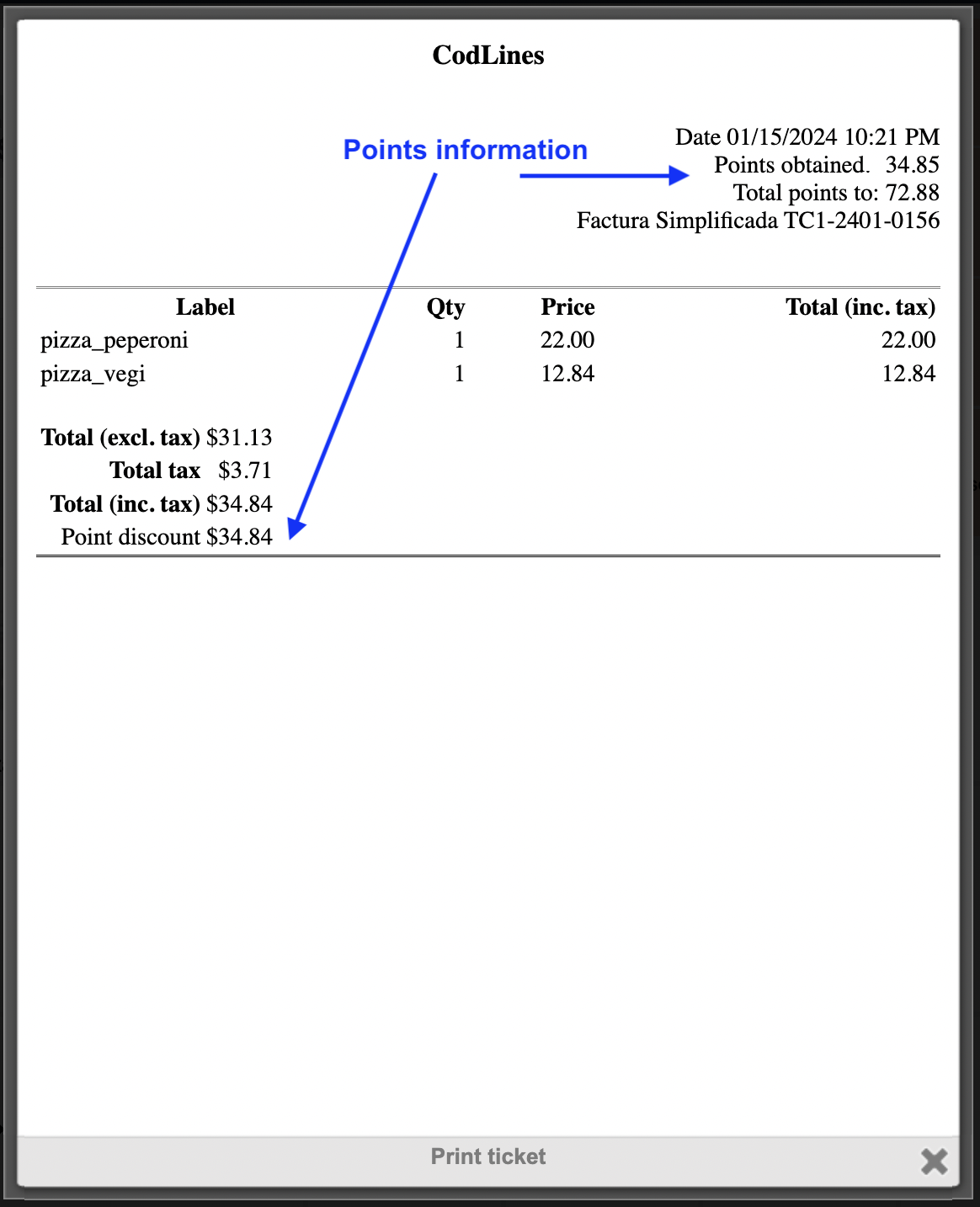
Recibo de de TakePOS
12. Permissions: The module has permissions that help control user access to its management, the permissions are:

13. Product and category filters: Each loyalty rule can restrict which invoice lines give points, using include and exclude filters by product and/or category. Open the configuration of the rules and click the filter icon (the funnel) of a rule; the filter configuration opens in a pop-up window (lightbox). There you can add products or categories and choose the mode:


- Include: only the selected products/categories give points.
- Exclude: everything gives points except the selected products/categories.

Hovering the filter icon shows a tooltip with a summary of the configured filters. The same product or category cannot be added twice, and the selector hides the options already used (and, for categories, also the children of a category already selected). If a rule has no filters, the whole sale counts.
14. Calculation base: Each rule defines the base used to compute the points:

- Paid amount (historical): the points are computed on the paid amount, prorated according to the weight of the lines that qualify. It never gives points for amounts that were not paid.
- Line subtotal: the points are computed on the TTC subtotal of the lines that qualify, without prorating by the payment.
The base can be chosen when creating the rule and changed at any time from the rules list.
15. Category hierarchy: Categories are applied hierarchically: including or excluding a category also includes or excludes its subcategories. Because of this, once a category is in the list its subcategories are not offered for selection; in other words, it is not possible to include a parent category and exclude a specific child category.
16. Include/exclude priority: When a product is covered at the same time by an include filter and an exclude filter, the exclusion always wins. For example, if you include the category "Drinks" and exclude the product "X" (which belongs to "Drinks"), the whole category gives points except product "X". The module shows an informative notice about this priority and lists the overlaps detected in the current configuration. Because the categories of a product can change over time, these overlaps are kept in an audit history (see point 17), so it is possible to explain afterwards why a given line did or did not give points.
17. Histories (audit log): The module keeps an audit history of each loyalty rule so that, afterwards, it is possible to explain why a line did or did not give points. The history is opened from the clock icon of the rules list, in the module configuration; it opens in a pop-up window (lightbox) and shows three blocks for the selected rule:
- Rule configuration changes: records the changes of the rule fields (label, sales value per point, discount, minimum and calculation base). For each change it shows the date, the user, the action (add or update), the affected field and the old and new value. Only the fields that really changed are recorded, so numeric formats (for example 10 vs 10.00000000) do not generate false entries.
- Filter changes: records the addition and deletion of product/category filters, with date, user, action, type (product or category), a snapshot of the object name at the time of the change and the mode (include or exclude). The snapshot keeps the original name even if the product or category is later renamed or deleted.
- Detected include/exclude overlaps: records the overlaps detected between include and exclude filters, with date, source (recorded when configuring the rule or when computing the points), the invoice concerned, a description of the overlap and the user. This is kept as evidence, because the categories of a product can change over time and the overlap may disappear from the configuration without leaving a trace.
Each of these blocks shows the last 100 entries. In addition to these histories, each points movement keeps its own breakdown (details), visible on the customer and invoice tabs, which explains the points obtained per line.
18. Changelog:
- 1.10.0 – Audit log of the include/exclude overlaps (recorded both at configuration and at points calculation).
- 1.9.0 – Audit log of the loyalty rule configuration changes (label, points values, minimum, calculation base); informative notice about the exclusion priority and detection of include/exclude overlaps.
- 1.8.0 – Filter tooltip with a summary of the configured products/categories; filter configuration opened in a lightbox; duplicate control (same product/category cannot be added twice); hierarchical categories (a parent category covers its subcategories); audit log of the filters configuration changes.
- 1.7.0 – Filters by product/category per loyalty rule (include/exclude); calculation base per rule (paid amount prorated or line subtotal); breakdown (details) of each points movement, visible on the customer and invoice tabs; log of the points calculation.
- 18.0.0 / 17.0.0 / 16.0.0 – Compatibility with Dolibarr 18 / 17 / 16.
Web Hosting
